

Invisible role, a lasting impact: A Toolkit on the Reality of Caregivers in the Workplace

According to a recent survey (CAP Mental Health, 2025), 82% of caregivers in the workplace find it difficult to balance their professional responsibilities with their caregiving role. Without effective support for work–caregiving balance, they experience numerous challenges at work: mental or emotional overload, presenteeism, feelings of guilt, reduced performance or productivity, burnout, and more.
Despite these avoidable impacts, 86% of respondents believe that workplaces in Quebec are poorly or not at all equipped to support caregivers in mental health. Indeed, many common barriers to balancing work and caregiving responsibilities still exist in the workplace.
This toolkit was created to shed light on the reality of caregivers in the workplace, support employees, and equip employers!
Are you supporting someone living with a mental health condition?
Resources are available to support you! Check out our fact sheet Caregivers in Mental Health: You’re Not Alone.
To learn more about balancing your role as a caregiver for someone living with a mental health condition and your responsibilities as a worker, we invite you to read our dedicated article on the topic (english coming soon). While you’re there, take a moment to explore the platform: CAP Mieux-Être (english coming soon) is a valuable resource designed to support your well-being as you care for a loved one living with a mental health condition.
Support is within reach! Our member organizations, located across all regions of Quebec, offer free and confidential services. Don’t hesitate to contact them: 1 855 272-7837

Supporting caregivers, more than just a kind gesture!
Supporting caregivers in mental health is a win-win investment for both employers and employees:
- Reduced absenteeism and presenteeism
- Greater employee retention
- Increased productivity and efficiency
- Stronger employer brand image
According to Concilivi (2023), organizations that implement work–caregiving balance measures benefit from 20% higher retention rates.
As reported by the Ministère du Travail, de l’Emploi et de la Solidarité sociale, companies in Quebec can recover up to $13 for every $1 invested in workplace health and wellness initiatives!

Employers, you can make a difference!
This toolkit is designed to support you in your efforts to assist employees who are caregivers for someone living with a mental health condition. We invite you to follow the four steps below to begin your journey:
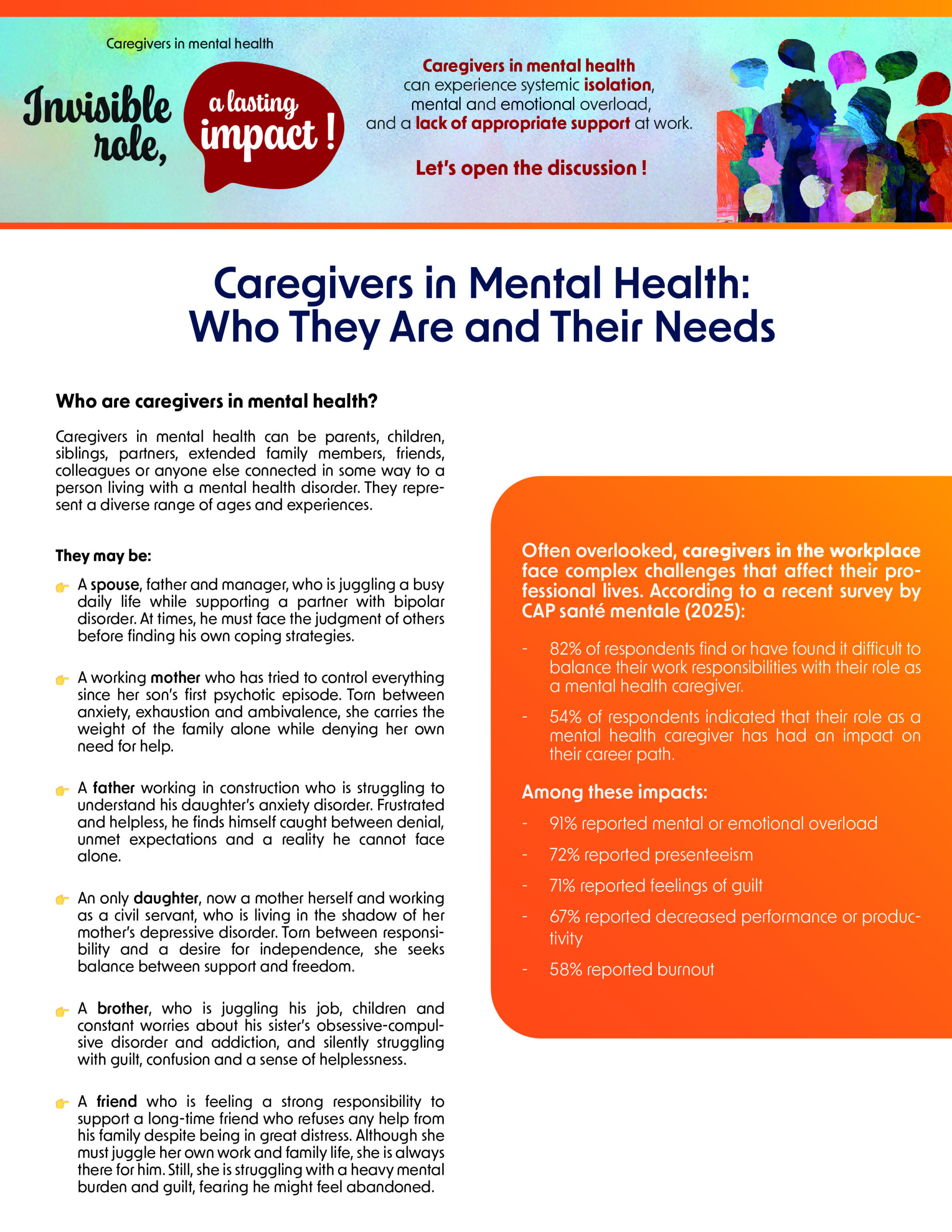
1. Get Informed
We’ve prepared a simple introductory fact sheet to give you a clear overview of who caregivers are, what their needs are, and why it matters to support them: Caregivers in Mental Health: Who They Are and Their Needs.
To go further, we invite you to read our article (english coming soon) on balancing the dual role of being a worker and supporting a loved one living with a mental health condition.
Stay tuned for upcoming video clips and webinars throughout the week — all valuable resources to help you start exploring the topic. All the details are available at: capsantementale.ca/en/campagne2025
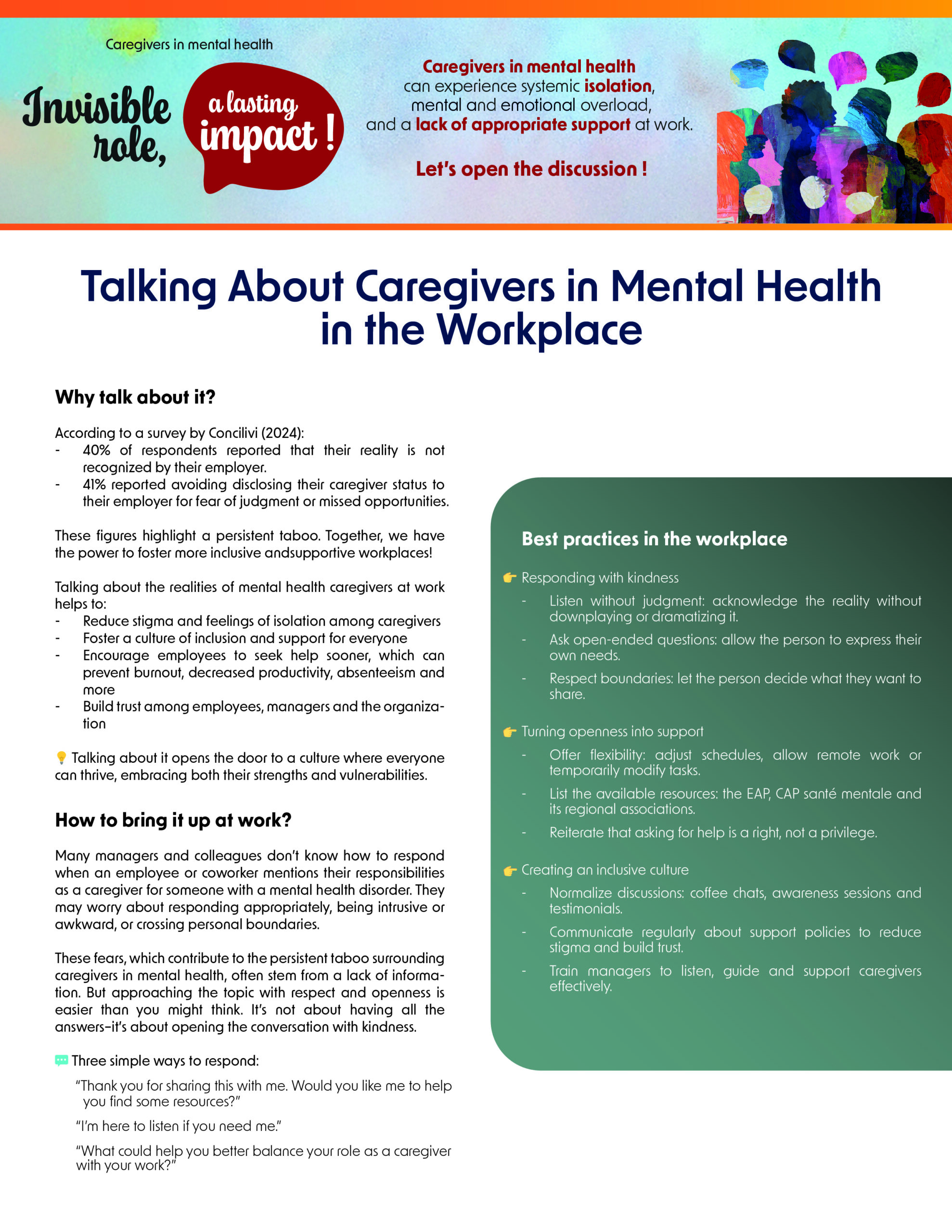
2. Open the Discussion
You don’t need to be an expert to open the conversation about this topic in your workplace!
To learn more about how to approach the subject, check out our specially designed fact sheet: Talking About Caregivers in Mental Health in the Workplace.
To support you in your efforts, we’ve also prepared some activities to help spark discussion within your teams. Discover three short activities made with workplaces in mind: Activities to open the discussion.
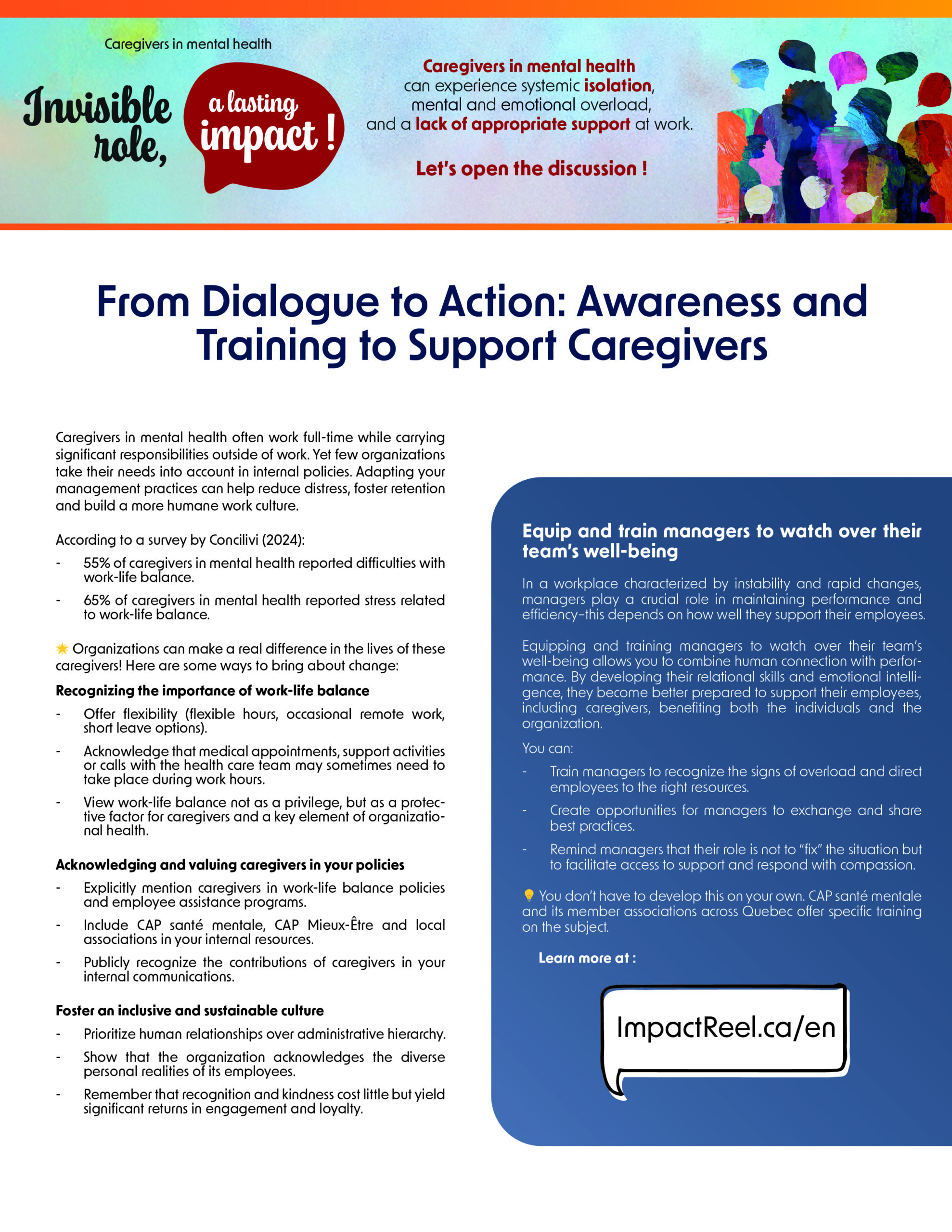
3. Put Your Commitment into Action
Now that you know more about the topic and the conversation has started within your company, how can you best demonstrate your commitment to the well-being of caregivers? Learn more about what you can practically do to support caregivers in your workplace with our fact sheet: From Dialogue to Action: Awareness and Training to Support Caregivers.
Our partner, Concilivi, whose mission is to support employers in implementing family–work balance measures adapted to the new realities of work and employee needs, offers several fact sheets and practical guides (only in french) to help you improve your reconciliation practices. Take the time to explore these valuable resources!
Want to go further? Our member organizations across Quebec are available to provide tailored support regarding the reality of caregivers in mental health (training on caregivers’ experiences, workplace training, and more).
Looking to make broader changes in your family–work balance or workplace well-being practices? Our partners, Concilivi and Coesion SP, offer training, resources, advice, personalized support, and much more!
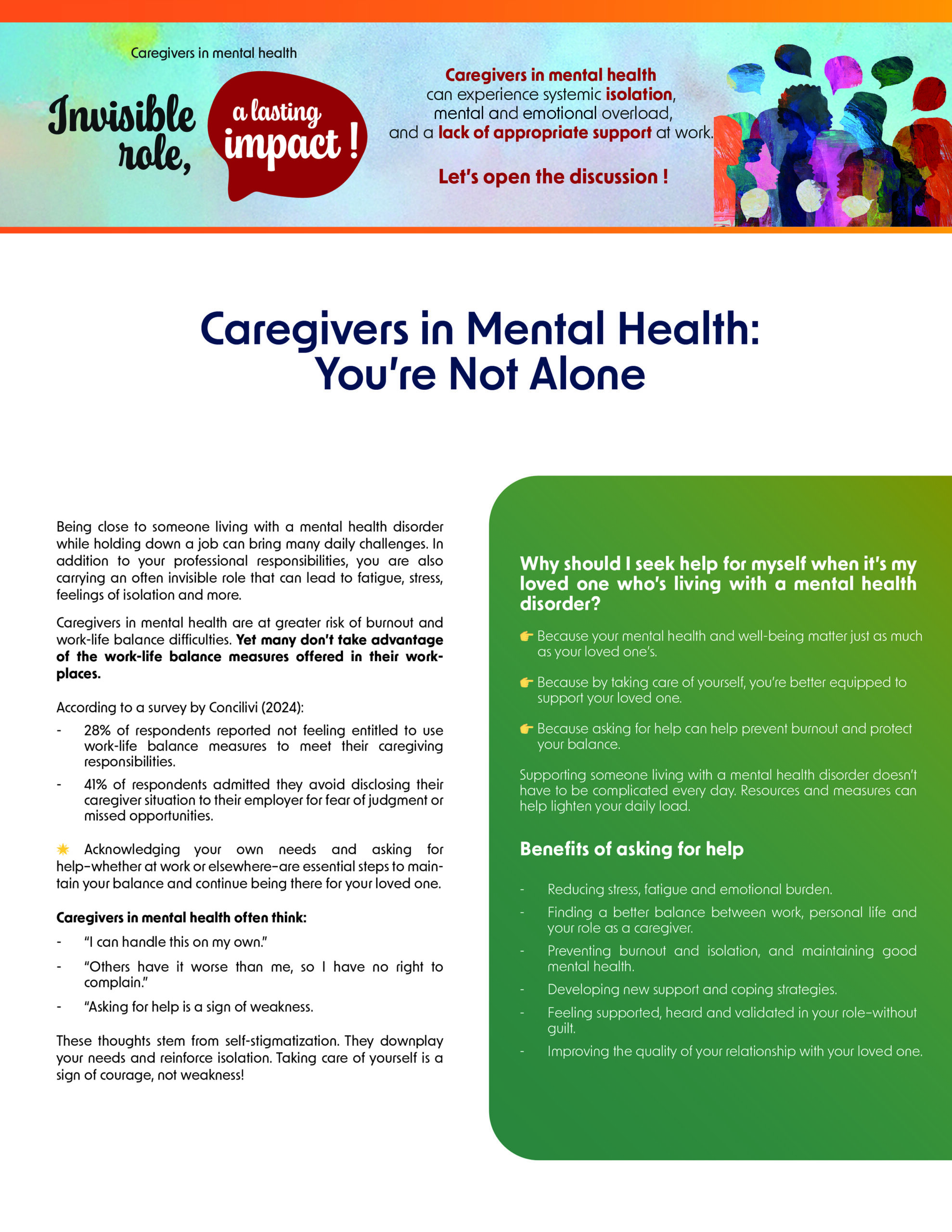
4. Keep the Conversation Going
Don’t let your efforts fade away — keep the discussion alive! Regularly remind your team about the available resources: during team meetings, via email, on bulletin boards, in the staff room, or elsewhere.
Our final info sheet is specifically designed for caregivers in the workplace. Feel free to refer them to it or make it available in common areas: Caregivers in Mental Health: You’re Not Alone.
We also provide a print kit including a poster, a brochure, a business card, a door hanger, and fact sheets — everything you need to create visual reminders about the resources available to caregivers in your workplace!
Congratulations!
You are on the right path to making your workplace inclusive and supportive for caregivers in mental health.
Download the complete toolkit

– Four fact sheets
– One activity sheet to open dialogue
– One file with seven fact sheets et guides by Concilivi (only in french)
– Five video clips
– One print kit
To learn more about our current campaign, visit: capsantementale.ca/en/campagne2025
To Learn More
Complementary contents

PRESS RELEASE | Let’s open the discussion! A new initiative has been launched to support caregivers in mental health in the workplace
Read the article
To watch
Videos

Testimonial from Jennifer Johnson, Executive Director of the CHSSN
In this video clip, Jennifer Johnson, Executive Director of the CHSSN, shares insight about fostering work-family balance for caregivers of people living with mental illness. She also talks about the challenges and strengths of caregivers, and building trust in the workplace.

Testimonial from Martin Gauthier, manager and caregiver
As part of our 2025 awareness campaign on the reality of caregivers in mental health, we are thrilled to have Martin Gauthier, manager and caregiver, as an ambassador! We invite you to watch this video clip, in which he shares his personal testimonial about balancing...
As part of our 2025 awareness campaign on the reality of caregivers in mental health, we are thrilled to have Martin Gauthier, manager and caregiver, as an ambassador! We invite you to watch this video clip, in which he shares his personal testimonial about balancing his work with his role as a caregiver. As a manager, Martin also presents his compassionate approach toward supporting his employees.

Testimonial from Mylène Laroche, CEO of Sigmund
In this video clip, Mylène Laroche, CEO of Sigmund, discusses how to promote work-family balance for caregivers supporting individuals with mental health challenges. She talks about the strengths of caregivers, the employer’s supportive role, the challenges this can bring as an employer, and the importance...
In this video clip, Mylène Laroche, CEO of Sigmund, discusses how to promote work-family balance for caregivers supporting individuals with mental health challenges. She talks about the strengths of caregivers, the employer’s supportive role, the challenges this can bring as an employer, and the importance of trust and open dialogue within the team.

Testimonial from Marie Josée Aubé, Project Manager at l’ASSOCIÉ
In this video clip, Marie-Josée Aubé, Project Manager at L’ASSOCIÉ, shares some of the well-being initiatives implemented in her workplace. She also talks about the recognition of caregivers in society, human-centered leadership, and the collective impact of opening up dialogue.

Testimonial from Corinne Vachon Croteau, Executive Director of the Réseau pour un Québec Famille
In this video clip, Corinne Vachon Croteau, Executive Director of the Réseau pour un Québec Famille, discusses work-family balance. She specifically addresses the recognition of caregivers’ realities in our society, the challenges and impacts faced by those supporting loved ones with mental health issues, and...
In this video clip, Corinne Vachon Croteau, Executive Director of the Réseau pour un Québec Famille, discusses work-family balance. She specifically addresses the recognition of caregivers’ realities in our society, the challenges and impacts faced by those supporting loved ones with mental health issues, and examples of organizational measures.
Practical resources
Toolbox
Jade’s story
Jade lives with her mother who was diagnosed with Borderline Personality Disorder a few years ago. Learn about how she learned to set limits, communicate better and where to go on the web to better understand.
TéléchargerChristiane’s story
Christiane has a 38-year-old son who was diagnosed with schizophrenia at the age of 18. Learn about how she manages her emotions, how she found her place in his recovery and how she gained new perspective on the mental health problem.
TéléchargerOlivia’s story
Olivia has a brother who lives with a mental health problem. Learn about how she deals with the taboos and prejudices of others, how she found her role and place in her family and why she seeked help even if she isn't the one living with a mental health problem.
TéléchargerMartin’s story
Martin has been in a relationship with his partner for 25 years and they have four children together. Learn how he reconciles his role as a partner, parent and colleague without burning out, how he deals with his friends' lack of understanding and how he stopped feeling isolated in his family environment.
TéléchargerThe Caregiver’s Ally in Mental Health
This guide created especially for the family and friends of a person living with a mental health issue by Friends for Mental Health will be your ally throughout your journey as a caregiver!
TéléchargerCaregivers in Mental Health: You’re Not Alone
Supporting someone living with a mental health condition doesn’t have to be complicated every day, there are resources and measures that can make your daily life easier. Check out this fact sheet to learn more!
Télécharger